
Influencer Marketing Is a Media Channel -Start Treating It Like One
The Problem: We’re Thinking About Influencers All Wrong
For years, brands have approached influencer marketing like this:
“We need content. Let’s hire creators.”
So briefs are written like mini production assignments.
Deliverables are framed as posts, videos, stories.
Success is measured in likes, comments, and views.
And then everyone wonders why it doesn’t consistently drive real business outcomes.
Because that’s not what influencer marketing is.
At least, not anymore.
Influencer Marketing Isn’t Content. It’s Distribution.
Creators are not just content producers.
They are owned, engaged, and highly targeted distribution channels.
Each creator represents:
A defined audience
A level of trust
A repeatable reach pattern
A measurable impact on behaviour
That’s not content.
That’s media.
The Current Gap: Why Most Programs Underperform
Most influencer programs fail to scale because they’re built on the wrong foundation.
1. No Frequency Strategy
One post. One story. One video.
That’s not media planning, that’s a moment.
Real media works through frequency and repetition.
Influencer programs rarely do.
2. No Optimization Model
Once content goes live, most brands move on.
There’s no:
Performance-based reallocation
Audience-level optimization
Creative iteration based on data
In paid media, this would be unthinkable.
3. No Performance Framework
Metrics are often disconnected from outcomes:
Engagement ≠ intent
Reach ≠ conversion
Views ≠ revenue
Without a performance model, influencer marketing becomes a brand exercise, not a growth driver.
What It Looks Like When You Treat Influencer Like Media
When you shift the mindset, everything changes.
1. You Plan for Reach and Frequency
Multiple creators per audience segment
Layered exposure across time
Coordinated messaging across voices
You’re no longer buying posts.
You’re building reach curves.
2. You Optimize Like Paid Media
Double down on top-performing creators
Shift budget based on engagement quality
Test formats, hooks, and messaging
Creators become part of a living, evolving media plan.
3. You Tie It to Real Outcomes
Site traffic
Add-to-cart behaviour
Retail lift
SKU-level sales
Now influencer isn’t just “working”, it’s measurably contributing to revenue.
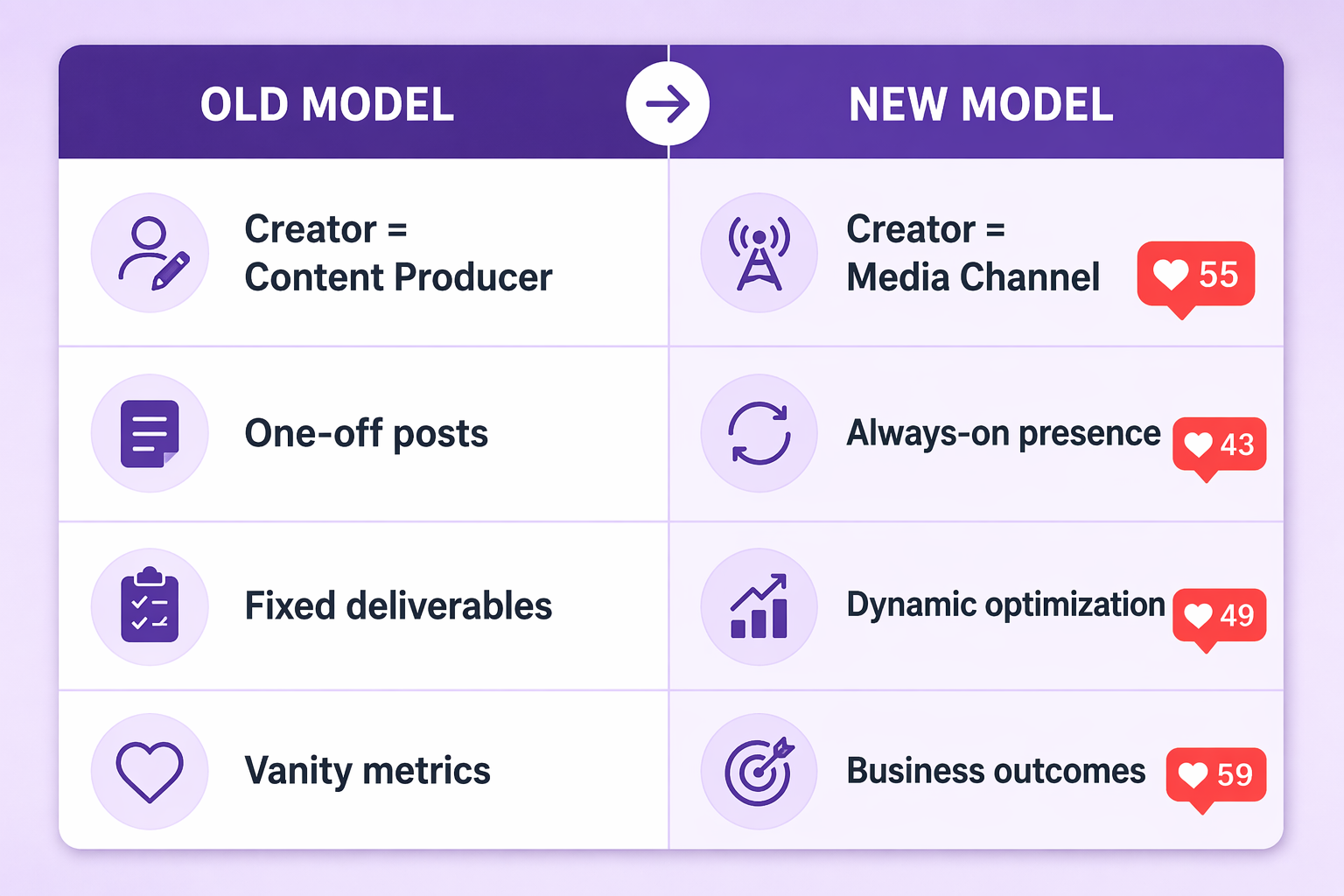
The Shift: From Creator as Content → Creator as Channel
This is the mindset change most brands haven’t made yet:
Why This Matters More Now Than Ever
The broader media landscape is shifting fast.
Platforms like Meta and TikTok are:
Increasingly pay-to-play
Fragmenting organic reach
Limiting deterministic tracking
At the same time, audiences trust creators more than brands.
That combination makes influencer marketing one of the most powerful and underutilized, media channels available today.
The JONES POV: Build Systems, Not Campaigns
Most brands run influencer campaigns.
We build influencer systems.
That means:
Always-on creator ecosystems
Integrated paid amplification
Retail and conversion alignment
Closed-loop measurement
Because the goal isn’t content.
The goal is consistent, measurable growth.
If your influencer strategy relies on:
One-off posts
Static creator lists
Engagement reports
You don’t have a media strategy.
You have a content plan.
And in today’s environment, that’s not enough.
If you’re ready to rethink influencer as a true media channel, and build a system that drives real business outcomes,
let’s talk.